Background: Over the years, humanitarian organizations, international NGOs, UN agencies, and local and national actors have jointly developed the Joint Response Plan (JRP) to respond to the needs of Rohingya refugees and the affected host communities in Cox’s Bazar. The JRP serves as the main humanitarian planning and fundraising framework, outlining sectoral priorities and the required financial resources for the response. Under this framework, humanitarian agencies and partner organizations prepare and implement activities for the Rohingya refugees living in Cox’s Bazar.
The CCNF (https://cxb-cso-ngo.org/) see some challenges within current system, areas improvement, and put some recommendations for the enhancement of localization agenda.
Existing system and challenges in JRP: The 2025–26 Joint Response Plan (JRP) outlines humanitarian assistance for Rohingya refugees and affected host communities in Cox’s Bazar and Bhasan Char. The plan targets 1.48 million people with USD 934.5 million (only for 2025, as the 2026 JRP is not publish yet).
 There are several key observations and recommendations regarding the Joint Response Plan and the overall Rohingya response.
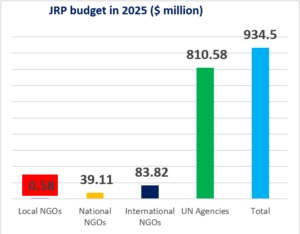
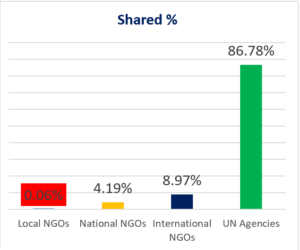
- UN Dominated Joint Response Plan: The 2025 JRP budget plan clearly demonstrates that the response remains heavily dominated by UN agencies. Out of the total USD 934.08 million JRP budget in 2025, UN agencies control approximately USD 810.58 million (86.8%) of the total plan. In contrast, International NGOs have only 8.97% shared, while National NGOs 4.19%. Most concerningly, Local NGOs have planned just 0.06% of the total JRP budget. This plan highlights a significant imbalance in planning stage, local organizations are far away on direct funding through JRP channel.
- 10 Appealing Partners Hold 91% JRP Budget: The 2025 Joint Response Plan (JRP) reflects a highly concentrated funding structure, where only ten organizations hold 91% of the total budget plan among 57 appealing partners. On the other hand, 47 appealing partners holds only 9% budget in JRP 2025. Major shares are controlled by UN agencies, including top WFP (34%), UNHCR (21%), IOM (14%), UNICEF (11%), UNFPA (4%) and BRAC (3%). This demonstrates limited financial space and influence for smaller national and local organizations. Even BRAC has more shared in the JRP than any other International NGOs.
- JRP is not an Inclusive Plan: The current or previous JRP isn’t holistic plan. The government of Bangladesh (GoB) is contributing a significnat both financial and in-kind contribution covering staff, security, and even taken loans for the response. This contribution is not reflecting in current JRP mechnaism. Rather it’s a UN-driven fundraising tool. Local government, district administration and RRRC participation in decision making process while preparing the JRP is limitted. The high government officials are not involved in the planning process. Previously ISCG, now RCT only the developed JRP with the government official for final approval.
- Affected Host Community Plan to be incldued: In the JRP 2026, the plan prepared exclusding the affected host community outside of the camps. The needs of the affected host communities living outside the camps, in Ukhia and Teknaf, were completely ignored. This omission is a clear violation of international commitments, as there are provisions to support the affected local communities. This plan fails to reflect that crucial commitment for affected host community.
- We Don’t Know the Management Cost, lack of Breakdown in JRP Budget: In previous years, the budget was segregated into activity costs, operational costs, and staff costs. For the transparency and accountability to the community, management cost and activity costs must be seregated. As funding declines, we must reduce these operational costs and direct more support toward the affected Rohingya communities, but the current JRP fails to reflect this necessary budget breakdown.
- Need commitment on funding directly channel to Local and National Orgnaiztions: The is no plan in the JRP that what amount or percentage of fund will be channelling to local orgnazations and national organziations. UN and INGos are raising fund based on the JRP plan. There is no dashboard of funding are channeling to whom.
- Need Extended support for the implemnetation of localization: ISCG/RCT helps for prepaing the JRP and collects funding reports from appealing partners on how much funding they raised under the JRP plan. In may case we observe that local organizations and even some INGOs able to raise only a small portion of the funds. Despite this, there’s no plan to actively support these local organizations in fundraising.
- Environmental Recovery Fund: Around 300 Acres of agricultural land adjacent to the Rohingya camps in Ukhia and Teknaf have reportedly been severely damaged due to the waste from the camps. Despite the scale of humanitarian investment, there has been little visible effort to restore this land or prioritize sustainable waste management systems that could protect local livelihoods and strengthen food security. This is particularly alarming because Cox’s Bazar district is the second most district in terms of food security and hunger indicators. The district’s economy and survival largely depend on forests, agriculture, rice cultivation, and salt production.
- Reduce dependency on underground water: Approximately 5-10% tube well either dry or produce saline water especially in Ukhiya. Around 2 Crore and 60 Lakh liters of underground water is extracting daily in Ukhiya and Teknaf for Rohingya refugees.
Recommednation:
Recommendation-1: Emphasis on Repatriation in Humanitarian Response: All humanitarian and relief interventions should maintain a clear focus on the ultimate objective of Rohingya repatriation. Humanitarian agencies must avoid activities that may create perceptions of permanent settlement among the Rohingya population. Every agency engaged in the Rohingya response should clearly explain how its activities contribute to creating conditions supportive of repatriation to Myanmar.
Recommendation-2: Review and Strengthen Camp Security System: The security situation in the Rohingya camps has deteriorated significantly, with criminal incidents becoming increasingly frequent and raising serious concerns among host communities. The Government of Bangladesh should urgently review the existing camp security system and take necessary measures to strengthen law enforcement within the camps.
Recommendation-3: Recognition of Rohingya Citizenship and Political Rights: The humanitarian response under the JRP largely treats the Rohingya only as beneficiaries of relief assistance, with limited attention to their citizenship and political rights. Alongside humanitarian support, UN agencies and INGOs should work collectively to advocate for and promote the Rohingyas’ citizen and political rights. They should also work to ensure the justice of genocide of Rohingya.
Recommendation-4: Formation of a Rohingya Repatriation Commission: Currently, more than 1.3 million Rohingya refugees are residing in Cox’s Bazar, while over 200,000 additional refugees have reportedly entered Bangladesh during the past two years. Despite ongoing humanitarian efforts, visible progress on repatriation remains absent, creating growing concerns among the people of Cox’s Bazar regarding the prolonged burden on Bangladesh.
In this context, a Rohingya Repatriation Commission will be formed under leadership of the Government of Bangladesh. The proposed commission would oversee and coordinate the repatriation process, develop a clear roadmap, ensure accountability, and regularly communicate progress and updates with local communities and stakeholders.
Recommendation-5: International Conference on Rohingya Repatriation at the UN General Assembly: Last year, the United Nations convened a high-level conference at the UN Headquarters in New York following a proposal from the interim government of Bangladesh. However, no similar initiative has yet been announced this year. The United Nations should organize an international conference during the UN General Assembly to mobilize stronger global support and sustainable solution for the Rohingya crisis. The conference should focus on establishing a concrete roadmap for the voluntary, safe, dignified, and sustainable repatriation of the Rohingya, while also advancing international accountability and justice for atrocities committed against them in Myanmar.
Recommendation-6: At least 25% fund for Local people with Local NGOs: Rohingya Coordination Team have to set target (at least 25% share in JRP) about how local organizations share can be increased gradually as appealing partners. There should be a plan on this. Field operation should be implemented by local and national NGOs. INGOs and UN agencies should remain in monitoring, technical assistance and fund raising. The JRP 2026 should include a comprehensive and dedicated plan for the affected host communities living outside the refugee camps, particularly in Ukhia and Teknaf. The response plan must recognize that local communities have been significantly impacted by the prolonged Rohingya crisis and continue to face increasing pressure on livelihoods, natural resources, public services, infrastructure, and social cohesion. Excluding these communities from the JRP undermines the principle of equitable humanitarian response and does not adequately reflect international commitments to support affected host populations.
Recommendation-7: Support NGOs in Fund Rasing: We know that the UN agencies and INGOs have strong capacity in fundraising and large-scale fund management. They have well-established connections with donors. However, local organizations have limited linkage in fundraising with donors. In the JRP, we need a specific plan to strengthen the fund-raising capacity of local organizations, which is missing in JRP. While it is their responsibility to prepare budgets and submit them in the JRP, it is equally the UN’s responsibility to booster them. These local organizations often have limited networks and knowledge in fundraising. The JRP should actively support them, helping build their capacity so they can take on greater responsibility and secure more sustainable funding for their critical work. This will help implementation of localization, as local organization will have more access to direct funding.
Recommendation-8: Ensure Participation of Local Government in JRP Development Process: The JRP development process should be inclusive and ensure the active participation and decision-making roles of local government representatives, district administration, senior government officials, and the RRRC. Government contributions and perspectives must be fully integrated into the planning, implementation, and coordination processes.
Recommendation-9: JRP Budget Must Be Transparent by Breakdown the budget (Operation Cost, program cost and Allocation among NGOs): The JRP should ensure transparent budget breakdowns by separating activity, operational, staff, and management costs, enabling accountability, reducing excessive overheads, and prioritizing maximum resources for affected Rohingya communities.
The JRP should clearly specify and disclose the proportion of funding allocated to local NGOs, national NGOs, international NGOs, and UN agencies, including transparent clarification on how the funds will be utilized by each of agencies.
Recommendation 10: Environmental Recovery Fund and Supply Naf River Water: We must ensure the sustainable natural resource management for the future generations in Cox’s Bazar. Local people and local government demend environmental recovery fund. Naf river water have to be supplied through treatment instead of underground water extraction. We have to create alternative water source and inject water underground through excavating ponds.
Note: Definition of Local orgnaiztion: Local NGO defines as the organization originated in a local community and grown up with the local leadership is considered as local NGO. We can also say that “the NGO or its leaders are originated from Coxsbazar”, and the “national” means who work nationwide.