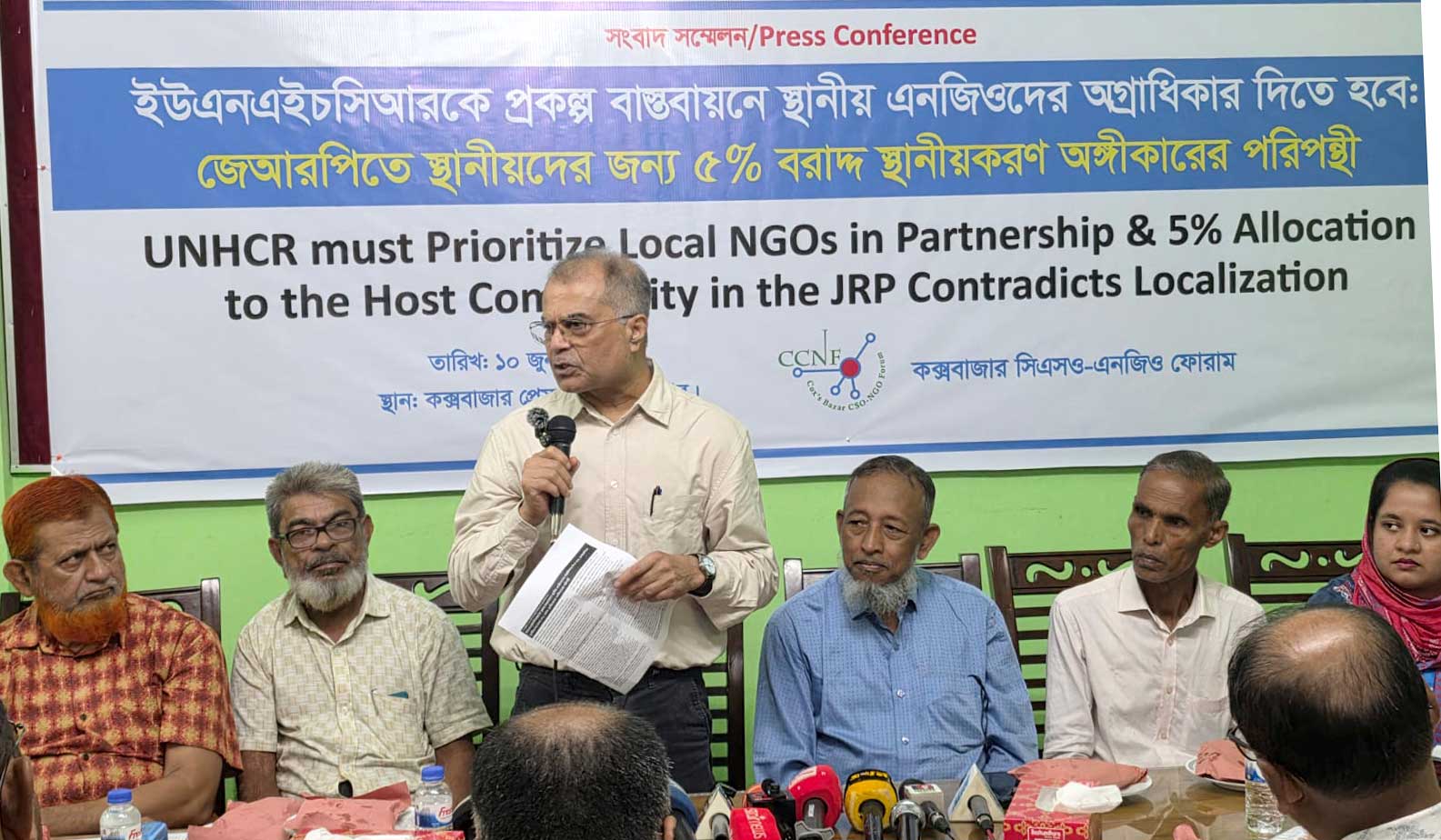
UNHCR must prioritize Local NGO in partnership and a 5% allocation to the host community in the JRP contradicts localization
Background: In Bangladesh, the Rohingya crisis has now been ongoing for nine years, with over 1.2 million Rohingya refugees residing in Cox’s Bazar, making it the world’s largest refugee crisis. Since 2017, the Bangladesh government, local communities, and organizations have provided critical support, alongside international agencies. Yet, even after nine years, Bangladesh faces immense challenges, and the burden is unbearable.
Important role of JRP: We recognize that both local organizations and international NGOs play key roles in fundraising for the Rohingya. In particular, we believe the UN has a significant role in mobilizing resources. According to the JRP, the UN’s fundraising capacity is unique. And we firmly believe that the JRP should be inclusive, ensuring both local and national organizations and the UN have a seat at the table, in line with localization and other key commitments.
Local NGO participation was excluded in the JRP 2026 launching: JRP (Joint Response Plan, 2026) launched on 20 May 2026 in the UNHCR office in Dhaka. UNHCR, in view of the practice, has requested NGO representatives in the RCT (Rohingya Coordination Team) to select one to speak at the event. RCT has a WhatsApp group. Within a minute of the UNHCR proposal, Manish Kumar Agrawal, Country Director of an international NGO, Concern Worldwide, proposed another international NGO’s Country Director, Sumitra Mukherjee of Danish Refugee Council (DRC). COAST Foundation Executive Director, Rezaul Karim Chowdhury, wrote an appeal to the UNHCR, saying historically INGOs in Bangladesh have facilitated local and national NGO leadership, they facilitate the process and keep themselves behind. This is also their desire following the Grand Bargain and Charter for Change commitments. He opposed the decision of an INGO leader speaking with some reasons, i) as Local, National and International NGOs have a Platform in Cox’s Bazar (NGO Platform), let the platform decide the speaker at the JRP launch, not some individual, and ii) it should be a Bangladeshi citizen, i.e., a local or national NGO leader. Local and national NGO leaders were the first responders, and still, they are playing a greater role in the Rohingya response; they must be recognized in leadership.
Only UN agencies and INGO representatives spoke: Finally, UNHCR allowed DRC and BRAC to speak, and both are international NGOs. BRAC is a Bangladeshi-origin INGO and operating in multiple countries and was picked as a representative of national organizations. BRAC is an INGO and cannot replace the role of the local/ national NGO space in Cox’s Bazar.
Local voice ignored: Local NGOs that have grown in Cox’s Bazar and supported the Rohingya response since the beginning, such as COAST Foundation, were silenced. Despite COAST’s efforts to speak, their voice was excluded. We observed that local leadership, deeply rooted in Cox’s Bazar and possessing extensive contextual knowledge and experience, continues to be systematically overlooked in decision-making and response planning processes. We urgently call for a truly inclusive response, ensuring the voices of local organizations are heard and valued.
INGO DRC and Concern Worldwide violated their commitments: We found that the Danish Refugee Council (DRC) is a formal signatory of the Grand Bargain. With a specific focus on “Quality Funding” and “Localization”. But in Rohingya response in Bangladesh, they are ignoring the local leadership, which is against the commitments of the Grand Bargain. And Concern Worldwide is also a signatory to the Charter for Change, which advocates for similar localization principles and commitments to support local NGO and local leadership. But they are actions that show the opposite.
No progress on repatriation: Since early 2024, more than 150,000 new Rohingya have crossed into Bangladesh, adding to the over one million refugees already living in Cox’s Bazar. With no progress toward sustainable repatriation, these new arrivals have further intensified pressure on the already overcrowded camps and the host communities. At the same time, humanitarian agencies have been forced to reduce assistance due to shrinking funding and resource constraints. A critical question is now being raised by the people of Cox’s Bazar— How much longer can they continue to bear the burden, and what further sacrifices are to be made?
Host Community allocation reduced to 5% in JRP: After the arrival of over 1.2 million Rohingya in Cox’s Bazar, the local community has faced significant
Challenges impact. Initially, the Rohingya used firewood for cooking, which led to deforestation; hills were cleared, agricultural land was damaged, and lawlessness increased. Additionally, the local communities have been losing access to safe drinking water. In response to this, the NGO Affairs Bureau (NGOAB) of Bangladesh issued a circular on 15 July 2019 directing that 25 to 30 percent of foreign donations for NGO projects should be allocated to the local affected population. However, defying this policy, the current JRP allocates only 5% of funds for the locals.
Questionable UN OCHA Pooled Funding Allocation: Recently, UN OCHA allocated $150 million US government funding through UN pooled funds. And 92% of those funds were provided to the UN agencies and 8% to international NGOs. Although the UN OCHA has commitments to direct funding to local NGOs, it did not provide. On the other hand, they allocated the Pooled fund only to JRP appealing partners. UN OCHA has a plan to provide more US funding next year. As in JRP 2026, there is no local NGO as an appealing partner, and if the same situation continues, how will they allocate direct funding to local NGOs?
Why INGO partnership and funding concentration to one local NGO? Most of the UN agencies are doing partnership with international INGOs. Especially UNHCR has no local partner. Later, they included one questionable local NGO in Cox’s Bazar. This local NGO has more than 30 donor projects, and they have been backed by a group of communal missionaries. Our question why UN will be partnering with international NGOs? Why will funding be concentrated to international NGOs and one local NGO? This has created an imbalance in funding architecture.
We don’t know the management cost, lack of breakdown: UNHCR doesn’t publish its operation and management cost. UN direct operation is always highly costly. For ensuring the transperency and accountability, their management cost and operational costs should be published. As funding declines, we must reduce these operational costs and direct more support toward the affected Rohingya communities, but the current JRP and UNHCR fail to reflect this necessary budget breakdown.
Need commitment on funding directly to Local and National Organizations: There is no plan in the JRP on what amount or percentage of funds will be channeled to local and national organizations. The UN and INGOs are raising funds based on the JRP plan. There is no dashboard of funding, and channeling to whom.
Recommendations:
- At least 25% of the funds for local people via Local NGOs: Rohingya Coordination Team (RCT) has to set a target (at least 25% share in JRP) about how the local organizations’ share can be increased gradually as appealing partners. There should be a plan for this. The next JRP 2027, the UN should include a comprehensive and dedicated plan for the affected host communities.
- Donors should reduce funding via UN and increase direct funding to Local NGOs: We urge donors to reduce funding via UN agencies and increase direct funding to local NGOs. Local NGOs are ready to make consortium to channel funds in Rohingya response.
- Say, No to JRP, Government Response Plan has to be developed: JRP 2026 have to review. We urge the Bangladesh government to reconsider this when approving the JRP, ensuring that future plans are more balanced, must consider the needs of local people. This can be a new Government Response Plan (GRP), where the Government of Bangladesh will take the lead.
- The Need for Safe, Voluntary, and Dignified Repatriation and its Joint Repatriation Plan: For providing the humanitarian assistance, they prepare a Joint Response Plan. But they have to prepare a Joint Repatriation Plan for the repatriation process. In the Joint Repatriation Plan, a road map of repatriation has to be declared. Where Voluntary, Safe and Dignified repatriation will be paramount. The Rohingya community must be included in this process.
- Uphold Local Leadership: Local leadership and local voice must be ensured in all stages of the planning and decision-making process of JRP. International NGOs should support local organizations from the back. INGOs cannot replace the role of local and national NGOs. The total process reflects the deficiency of the Rohingya aid structure.
- UNOCHA direct funding to local NGOs: UNOCHA must ensure 25% direct funding to local organizations in the next allocation. In this process, they have to include the local NGOs in their registration and partnership process.
- No concentrated funding, open windows for all: Funding cannot be limited to one or two particular local NGOs. Rather, it should be allocated to diverse local NGOs for fairness and to keep their commitments to localization.
- Call for Participation of Rohingya Community and CCNF support: The Rohingya community, especially youth, women and community leaders, should come forward and organize their own community for peaceful coexistence and harmony. They should also work on stopping crime, the drug business and human trafficking in their community. We, CCNF, will support the Rohingya community in this regard.
Please download position paper [Bangla Position Paper] [English Position Paper]